Professional Flat Roof Repair in Coral Springs, FL
Flat and low-slope roofs on commercial buildings, multi-family properties, and residential additions throughout Coral Springs face unique challenges that pitched roofs don't. Ponding water, membrane deterioration, drain blockages, and failed seams require specialized diagnosis and repair techniques. We work with TPO, modified bitumen, and built-up systems across Broward County.
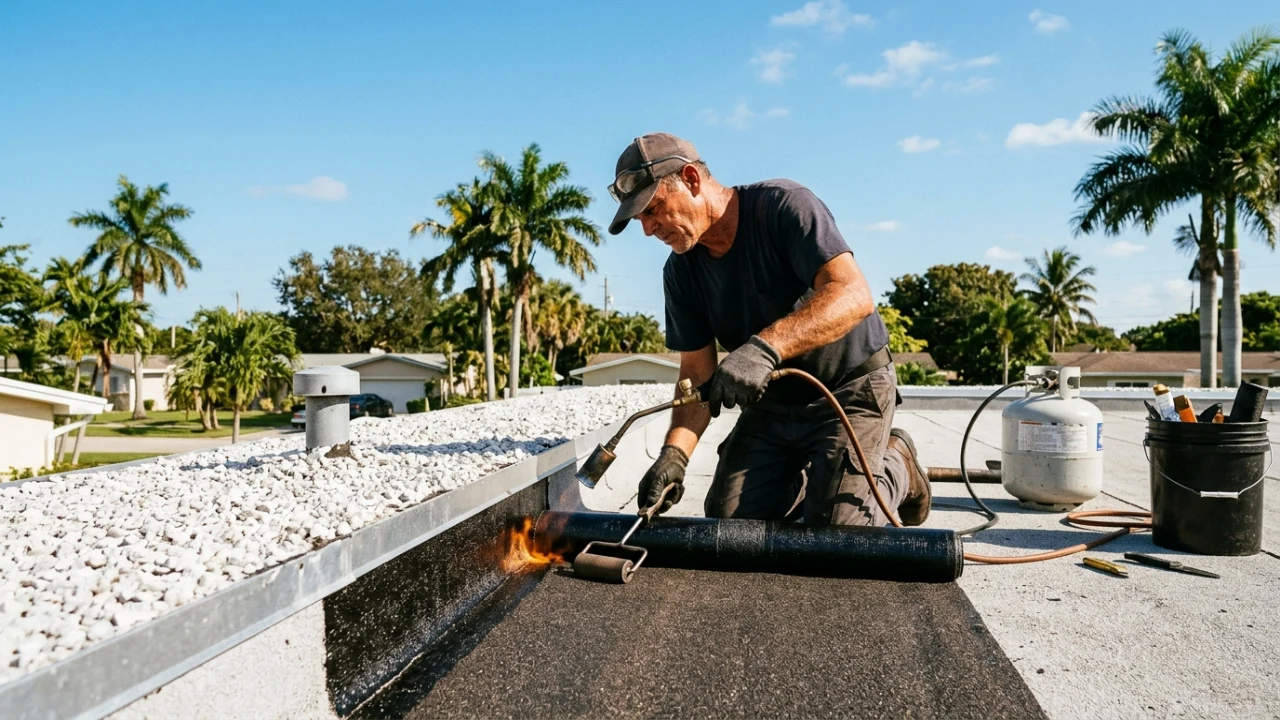
Signs Your Flat Roof Needs Professional Repair
Flat roof problems tend to escalate quickly because water has nowhere to run. Recognizing these warning signs early helps prevent interior damage and costly structural repairs.
Standing water visible 48+ hours after rain
Ponding water indicates insufficient drainage — caused by blocked drains, settled insulation, structural deflection, or improper slope. Chronic ponding degrades even well-installed membranes and adds weight load the structure may not be designed to carry.
Visible bubbling, wrinkling, or separation in the membrane
Blisters and bubbles indicate trapped moisture beneath the membrane surface. These areas are vulnerable to puncture, and once opened, they allow direct water entry to the insulation and deck below. Wrinkled or fish-mouthed seams signal adhesion failure.
Interior leaks or moisture stains on commercial ceilings
Water stains on drop ceiling tiles, damp spots on concrete decks, or dripping near interior walls often trace back to flat roof leak sources — particularly at drain connections, equipment curbs, and perimeter edge details.
Cracked, alligatored, or deteriorated surface texture
Built-up and modified bitumen roofs develop a cracked, alligator-skin surface pattern when the asphalt binder dries out from UV exposure. This cracking allows moisture into the roof system and signals that the membrane is nearing the end of its serviceable life.
Observations You Can Make on Your Flat Roof
Flat roofs are generally safer to access than pitched roofs — but always exercise caution near edges, skylights, and areas with standing water. These checks help you identify problems worth investigating professionally.
Check drains, scuppers, and gutters for blockages
Leaves, debris, and sediment frequently block flat roof drainage points. A blocked drain or scupper turns the entire roof into a retention pond during heavy Coral Springs rainstorms — multiplying the stress on seams and penetrations.
Look for areas where water ponds after rain
Note where water collects and how long it persists. If specific areas consistently hold water more than 48 hours after rain, document the locations — this information is valuable for the inspection team.
Walk the perimeter and check edge flashings
Edge flashing and coping that has pulled away from the wall or parapet creates an entry point for wind-driven rain. Look for visible gaps, rusted metal, or caulk that has dried and separated.
Inspect around rooftop equipment and penetrations
AC units, exhaust fans, and pipe penetrations are common leak sources on flat roofs. Check for cracked flashing boots, separated sealant, or membrane damage around equipment curbs.
Note the membrane condition in high-traffic areas
Areas regularly accessed for equipment maintenance show accelerated membrane wear. Scuff marks, thin spots, and small punctures from dropped tools or equipment parts create vulnerabilities that worsen over time.
Common Flat Roof Failure Points
Flat roofs fail differently from pitched roofs. Without gravity-assisted drainage, every seam, penetration, and edge detail must perform flawlessly — and the intense South Florida climate tests them constantly.
Open or Failed Seams
Membrane seams — where two sheets overlap and are welded, adhered, or sealed — are the most common flat roof failure point. Heat-welded TPO seams can separate from thermal cycling. Adhered modified bitumen seams lose their bond from moisture intrusion beneath. Failed seams allow water directly into the insulation layer.
- Visible gaps or lifting along membrane overlaps
- Fish-mouthing at seam edges
- Water staining along seam lines on the ceiling below
Drain & Scupper Failures
Interior drains, scuppers, and overflow outlets must handle the full rainfall volume from the roof area they serve. Clogged drains pond water. Corroded drain flanges and deteriorated lead pans create leak points at the lowest point on the roof — where water naturally concentrates.
- Persistent ponding near drain locations
- Corroded or deteriorated drain hardware
- Interior leaks directly below roof drain positions
Membrane Punctures
Foot traffic, dropped tools, storm debris, and even bird pecking can puncture flat roof membranes. On thin single-ply systems, a small puncture may not be visible from the surface but allows steady water migration into the insulation beneath.
- Saturated insulation beneath apparently intact membrane
- Small tears or holes near equipment access paths
- Localized soft spots when walking the roof
Perimeter Edge & Wall Flashing
Where the membrane meets parapet walls, edge metal, or building facades, flashing must create a watertight transition. Thermal movement, building settling, and UV degradation all contribute to flashing separation at these critical details — allowing wind-driven rain into the wall assembly.
- Flashing pulling away from wall surfaces
- Dried, cracked caulk at flashing terminations
- Water staining on interior walls below roof edges
Equipment Curb Penetrations
AC units, exhaust fans, and ductwork sit on curbs that penetrate the membrane. The membrane-to-curb detail requires proper boot or flashing integration. Vibration from running equipment, thermal movement, and poor original installation all contribute to curb flashing failure over time.
- Cracked or separated membrane at curb corners
- Deteriorated pitch pockets around equipment supports
- Leaks that correlate with AC unit locations below
Saturated Insulation & Deck
When water enters a flat roof system, it spreads laterally through the insulation layer — often traveling far from the original entry point before finding a path to the ceiling below. Saturated insulation loses its thermal value and adds weight. Prolonged moisture exposure deteriorates the roof deck beneath.
- Soft, spongy areas when walking the roof
- Insulation visible through membrane tears
- Dark moisture staining on deck undersurface
Why Flat Roofs Demand a Different Repair Approach
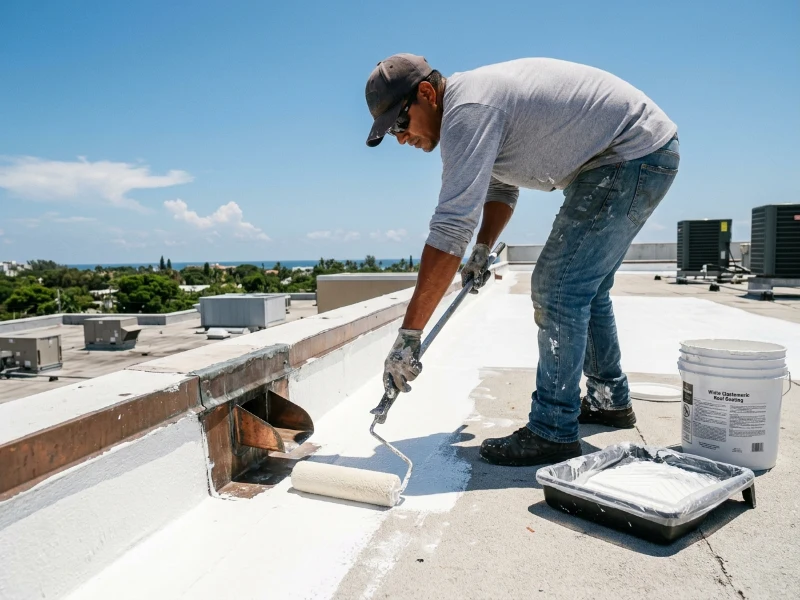
Pitched roofs shed water by gravity. Flat roofs retain it. This fundamental difference means that every repair detail — every seam, every penetration flashing, every edge termination — must be absolutely watertight. There's no downhill slope to carry water past a marginal repair.
In Coral Springs, the challenge is compounded by intense UV that degrades membranes, thermal cycling that stresses seams, and seasonal downpours that can dump several inches of rain in an hour. A flat roof that drains poorly is simultaneously baking in the sun and sitting in water — the worst combination for any membrane system.
Effective flat roof repair starts with identifying the membrane type, understanding its specific failure modes, and using compatible materials. A TPO patch on a modified bitumen roof won't adhere properly. Solvent-based adhesive on a PVC membrane will destroy it. Material identification is the first step, not an afterthought.
How We Diagnose and Repair Flat Roofs
Flat roof repair requires a systematic approach that accounts for water's ability to travel laterally, membrane compatibility, and the unique drainage demands of low-slope systems.
Identify the Membrane System and Condition
We determine the membrane type — TPO, EPDM, PVC, modified bitumen, or built-up — and assess its overall condition. We check for UV degradation, alligatoring, membrane thickness, and adhesion quality to establish whether localized repair or broader intervention is appropriate.
Locate Leak Sources and Moisture Entry Points
We inspect seams, penetrations, drains, edge flashings, and equipment curbs — correlating exterior findings with reported interior leak locations. On larger roofs, we may section areas to isolate the leak zone, especially when water has traveled laterally through insulation.
Evaluate Drainage and Ponding Conditions
We assess whether drains, scuppers, and gutters are functioning properly and whether the roof slope directs water to drainage points. Chronic ponding areas are documented and addressed as part of the repair — either by clearing blockages, adjusting slope with tapered insulation, or improving drain capacity.
Complete Repairs with Compatible Materials
We patch punctures, re-weld or re-seal seams, restore penetration flashings, and address edge details using materials compatible with the existing membrane system. After the repair, we verify water flow to drains and confirm that all repaired areas are sealed against the next rainfall.
Flat Roof Repair Scope Based on System Condition
Flat roof repair scope varies significantly based on the membrane condition, insulation integrity, and drainage function. Here are the typical repair scenarios.
Flat Roof Repair FAQ
Water should drain within 48 hours. Standing water beyond that threshold — commonly called ponding — indicates drainage problems, structural deflection, or insufficient slope. Ponding accelerates membrane deterioration, adds weight stress to the structure, and increases the risk of leaking through any compromised seam or penetration.
In some cases. Reflective coatings can reduce UV damage and surface temperature, potentially extending membrane life when applied over a structurally sound, well-adhered membrane with intact seams. However, coatings applied over deteriorated, punctured, or poorly adhered membranes will not resolve underlying problems and may delay necessary repairs.
Blisters form when moisture trapped beneath the membrane vaporizes under Florida's intense heat, creating pressure that separates the membrane from the substrate. The trapped moisture may have entered during installation, through a breach in the membrane, or through moisture migration from the building interior.
Heavy rainfall overwhelms compromised seams, failed flashing, or partially blocked drains that handle normal rain volume without issue. Wind-driven rain can also push water beneath edge flashing or through areas where the membrane has lifted. The leak may also be related to ponding that only reaches a critical depth during sustained downpours.
Not always. TPO, EPDM, PVC, and modified bitumen each require specific materials and adhesion methods for patches and seam repairs. Using incompatible materials can cause adhesion failure and create new leak points. We identify the existing membrane system before recommending repair materials to ensure compatibility.
Flat Roof Ponding, Leaking, or Showing Wear? Get an Evaluation
Whether your flat roof has ponding water, membrane damage, failed seams, or interior leaks, contact us for a professional evaluation. We'll identify the membrane type, locate the problem areas, assess drainage, and provide a written repair plan with material-compatible solutions.